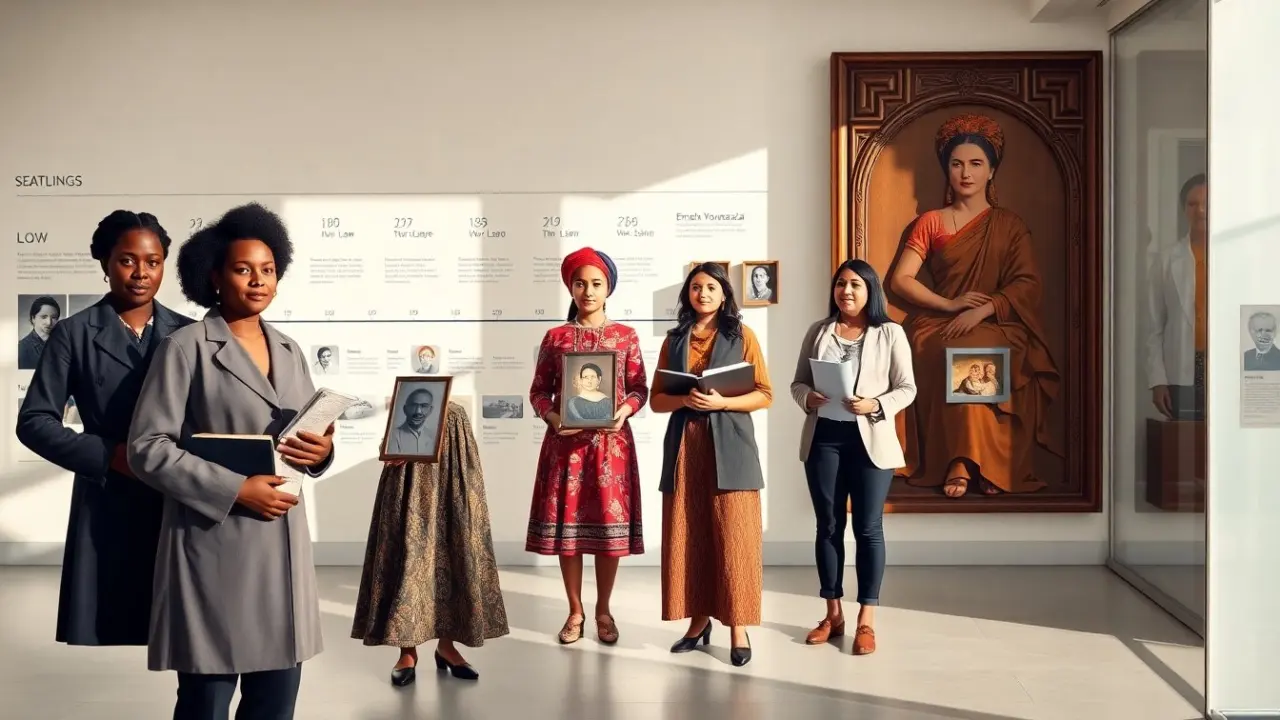
important women in history shaped law, science, art, and rights across centuries. This list highlights 25 important women in history who altered institutions and daily life. The piece names figures, explains actions, and connects their work to 2026. Readers will find clear reasons these important women in history still matter and where to start learning more about them. Rather than offering a single checklist of accomplishments, the article groups women by the kinds of structural change they helped bring about: legal reformers, scientific innovators, political leaders, cultural creators, and grassroots organizers. That framing helps readers see patterns of influence—how individual agency, networks, and institutions interact over time—and prompts concrete follow-up: what to read next, which archives to consult, and simple actions to carry these legacies forward in education, policy, and community life.
Key Takeaways
- Important women in history have shaped law, science, culture, and rights through measurable and lasting impact worldwide.
- Figures like Marie Curie, Harriet Tubman, Wu Zetian, Frida Kahlo, and Malala Yousafzai exemplify diverse paths to influence across eras and regions.
- These women drove legal reforms, scientific breakthroughs, cultural shifts, and human-rights advancements that continue to affect society today.
- Studying biographies and primary sources of these women offers practical lessons in leadership, activism, and scholarship.
- Individuals can honor their legacy by supporting education, mentoring, civic engagement, and promoting diverse representation in research and policy.
- Small local actions inspired by these women can scale up to meaningful changes in laws, social norms, and institutional policies.
- Using a clear, consistent historical lens—impact, evidence, leadership, and longevity—helps evaluate other deserving figures beyond this list.
- To deepen understanding, combine secondary reading with primary documents, oral histories, museum collections, and community memory projects.
How We Selected These Women And The Historical Lens Used
The team used four simple criteria to choose the important women in history. Each woman had clear impact, evidence of change, documented leadership, and lasting influence. The list balances geography and era to show global patterns, seeking examples from premodern courts to contemporary movements. The selection prioritized primary sources, reputable biographies, and peer-reviewed studies as the basis for inclusion; where the documentary record is sparse, the entry flags uncertainty and points to ongoing revision by historians. Methodologically, we counted several kinds of outcomes: policy change (laws, court decisions, institutional reforms), scientific breakthroughs (new methods, training of successors, changes in practice), cultural shifts (new genres, public reception, pedagogical adoption), and human-rights outcomes (expanded access, legal protections, shifts in social norms).
We also paid attention to process: how did change occur? Was it through formal office, underground networks, published research, public protest, or creative work? Where possible we identify mechanisms—petitioning, coalition-building, publication and citation networks, patronage systems, or legal strategy—so readers can trace how an idea moved from an individual to an institution. The lens values measurable results and cultural resonance while acknowledging structural barriers—race, class, gender, empire—that shaped each woman’s opportunities and constraints. The list avoids single-trait selection and treats activism, scholarship, and art as valid forms of impact. It notes controversy and revision where records conflict and suggests further reading for contested cases. Finally, the reader can use the same lens to evaluate other important women in history by asking: What changed? What evidence supports that change? Who benefited? And how durable were the outcomes?
Five Landmark Women To Know Across Eras And Regions
Marie Curie appears as a clear example of science impact among important women in history. Curie won Nobel Prizes and changed medical care through radioactivity research, establishing laboratories and mentoring younger scientists who continued the work. Harriet Tubman shows direct action and system change among important women in history. Tubman led enslaved people to freedom and worked within abolitionist networks to pressure political institutions, illustrating how individual courage combined with organizing can alter legal regimes. Empress Wu Zetian represents political power and reform in early China among important women in history. Wu promoted merit examinations and administrative reform in ways that reshaped court staffing and governance practices. Frida Kahlo stands for cultural voice and personal expression among important women in history. Kahlo’s paintings and public persona expanded conversations about identity, disability, and national culture, influencing artists and activists who followed. Malala Yousafzai serves as a recent example among important women in history. Malala advanced girls’ education and brought sustained international attention to barriers facing young women in conflict-affected regions.
Each of these five women shows a different route to impact—scientific innovation, direct rescue and organizing, institutional reform from the center, cultural transformation, and global advocacy—and each illustrates recurring tactics: building institutions, training successors, publishing and speaking, legal engagement, and coalition formation. Beyond these five, the longer list includes reformers, inventors, writers, jurists, and organizers from diverse regions and eras; readers should view the five highlighted figures as archetypes that help clarify how to trace influence across contexts.
How Their Achievements Transformed Law, Science, Culture, And Rights
These important women in history changed law by pushing for new statutes, shaping landmark court decisions, and creating civic institutions that outlasted single campaigns. Some drafted model legislation, others mobilized voters, and several served as plaintiffs or counsel whose cases set legal precedents. In science, these important women in history published studies, developed experimental techniques, founded laboratories or clinics, and trained students who continued and diffused their methods; their work altered standards of care, research agendas, and educational practices.
In culture, these important women in history created art, music, literature, and public education initiatives that shifted how communities understand identity, memory, and belonging. Their work changed curricula, museum practices, and the languages available to express personal and political experience. In rights, these important women in history organized unions, led suffrage and civil-rights campaigns, and founded organizations focused on access to education, healthcare, and legal protection; those campaigns translated grassroots pressure into statutory and administrative change. The changes often started locally—neighborhoods, universities, or courts—and scaled to national or international law through networks of allies and institutional uptake.
Across these domains, common mechanisms recur: idea generation (research, manifestos, legal briefs), public persuasion (speeches, exhibitions, press), coalition building (cross-class and cross-regional alliances), and institutional embedding (founding schools, clinics, political parties, or NGOs). Recognizing these mechanisms helps explain why some efforts produced rapid change and others required decades to take effect. The stories of these important women in history show how small actions—teaching a class, filing a petition, publishing a paper—can set in motion wider transformations when combined with strategic partnerships and sustained follow-through.
Practical Ways To Learn More And Apply Their Lessons Today
Readers can study the biographies of important women in history to learn method and motive; complement those with primary documents such as letters, court records, scientific papers, and oral histories to see decision-making in real time. Visit local museums, university special collections, and digital archives that host manuscripts and recordings related to these women. Many public libraries and cultural institutions also maintain curated reading lists and educational packs that make primary sources accessible for teaching and community use.
Take one action that follows each figure: join a civic group that works on a relevant issue, support girls’ education programs, mentor a young researcher, or help preserve a local historical site. In classrooms and clubs, design short modules that pair a primary source with a practical project—draft a policy brief inspired by a legal reformer, reproduce a basic experiment from a scientific innovator under supervision, or curate a small exhibition highlighting a local woman’s life. In research and policy work, adopt habits that amplify neglected contributions: include women among cited sources, recommend diverse candidates for panels and awards, and assess proposed policies for differential impacts on gender and race.
Measure impact by setting simple, trackable goals: increase representation of women in syllabi, track mentorship hours provided, report changes in local funding for education or cultural programs, or document policy language that reflects historical precedents. Finally, share what you learn: public talks, school visits, op-eds, and community workshops help translate historical insight into civic practice. These steps make the lessons practical and repeatable, and help carry the legacy of important women in history into current work and local life.